New Arlozorov Forum report on the decoupling of wages from productivity in Israel
Author:
Yoni Ben-Bassat Date:
Since the early 2000’s, a process has been ongoing in Israel, wherein workers’ wages have been decoupled from workforce productivity. Had it not been for this process, the average wage in Israel in 2021 would have stood at NIS 13,648 - 16% more than its actual level of NIS 11,773 at the time. Concurrently, the labor share in the output has declined from approximately 74% in the early 2000s to 64% in 2021. These trends indicate a defect in the mechanism through which economic growth was supposed to raise the standard of living of the majority of the population - the wage mechanism. This problem is apparently an outcome of the falling bargaining power on the part of the workers. In order to reverse this trend and raise the population’s standard of living, the government has got to implement measures which will be supportive of the recoupling of the productivity and the real wages by strengthening the workers’ bargaining power, including through enlarging the percentage of organized workers and strengthening legislation which is protective of workers’ rights.
Since the early 2000’s, a process has been ongoing in Israel, wherein workers’ wages have been decoupled from workforce productivity. Had it not been for this process, the average wage in Israel in 2021 would have stood at NIS 13,648 – 16% more than its actual level of NIS 11,773 at the time. Concurrently, the labor share in the output has declined from approximately 74% in the early 2000s to 64% in 2021. These trends indicate a defect in the mechanism through which economic growth was supposed to raise the standard of living of the majority of the population – the wage mechanism. This problem is apparently an outcome of the falling bargaining power on the part of the workers. In order to reverse this trend and raise the population’s standard of living, the government has got to implement measures which will be supportive of the recoupling of the productivity and the real wages by strengthening the workers’ bargaining power, including through enlarging the percentage of organized workers and strengthening legislation which is protective of workers’ rights.
Abstract
Introduction
· Every industrialized country seeks to raise the standard of living of all its citizens. A key policy tool for this purpose is increasing productivity (output per work hour) which, in turn, increases wages. Thus for example, wages form a key tool for transferring part of the fruits of growth to the working public.
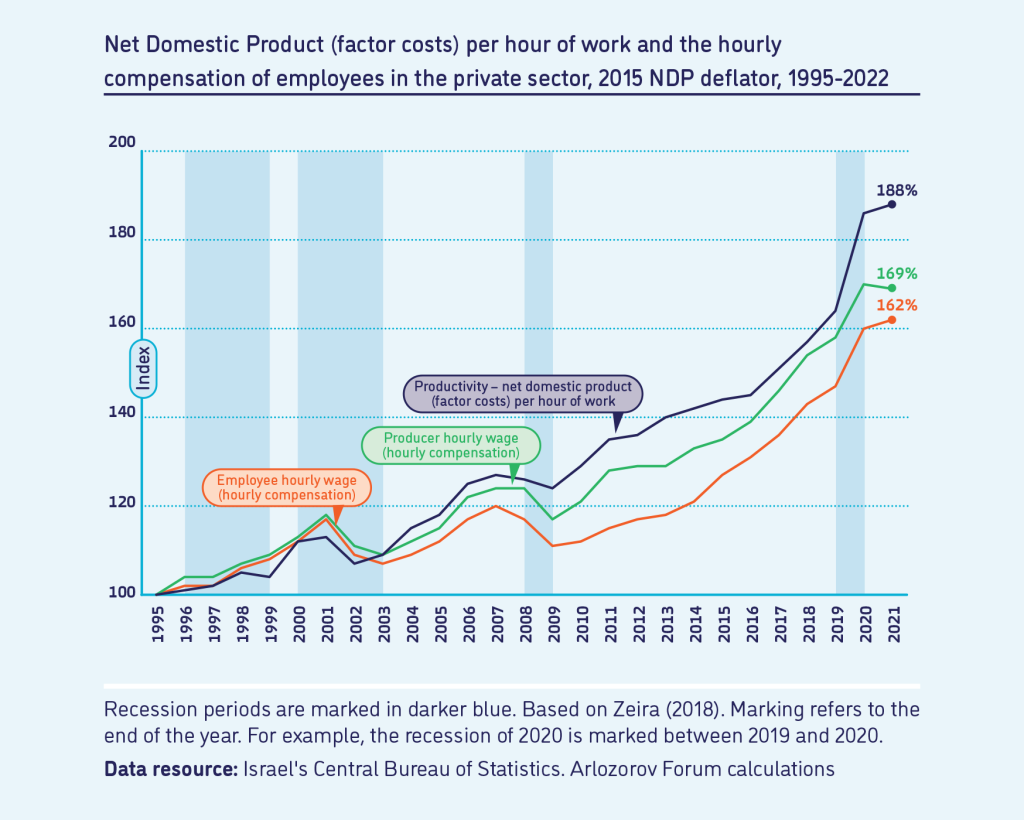
In the 1980s and 1990s, the pace of growth in productivity and wages in the Israeli business sector was similar. However, from the beginning of the 21st century and through to the present, a process of decoupling of wages from productivity has prevailed. Although the real wages for the average worker have increased, this has happened at a slower pace than the growth in productivity, which is indicative of a change for the worse in the machinery of spreading the fruits of growth.
Decoupling of Wages from Productivity
Beginning in 2004, a gap began to open up between the wage and productivity. This gap has not narrowed to this day, indicating a change for the worse in the machinery of transferring the fruits of economic growth to the working public.
The growth gaps occurred primarily in periods of recovery following economic crises at three particular points in time – 2003-2004, 2009 and 2020-2021. In the years between these three points in time wages and productivity have developed more or less at the same rate.
The decoupling of wages from productivity is a relatively new phenomenon. For approximately two decades, between 1981 and 2001, the rate of growth of wages in the Israeli business sector was relatively in step with the rate of growth in productivity. It is possible that the decoupling is indicative of a structural change the Israeli economy has undergone, which altered the way it responds to crises.
From the workers’ perspective, the link between their wages and their productivity has weakened even more over the period in review. Not only have wages decoupled from productivity, the price of the workers’ shopping basket has risen more than the shopping basket in the hands of the capital owners. Thus the wage they have been receiving has been hit twice.
Decline of labor share in output and increase in return on equity
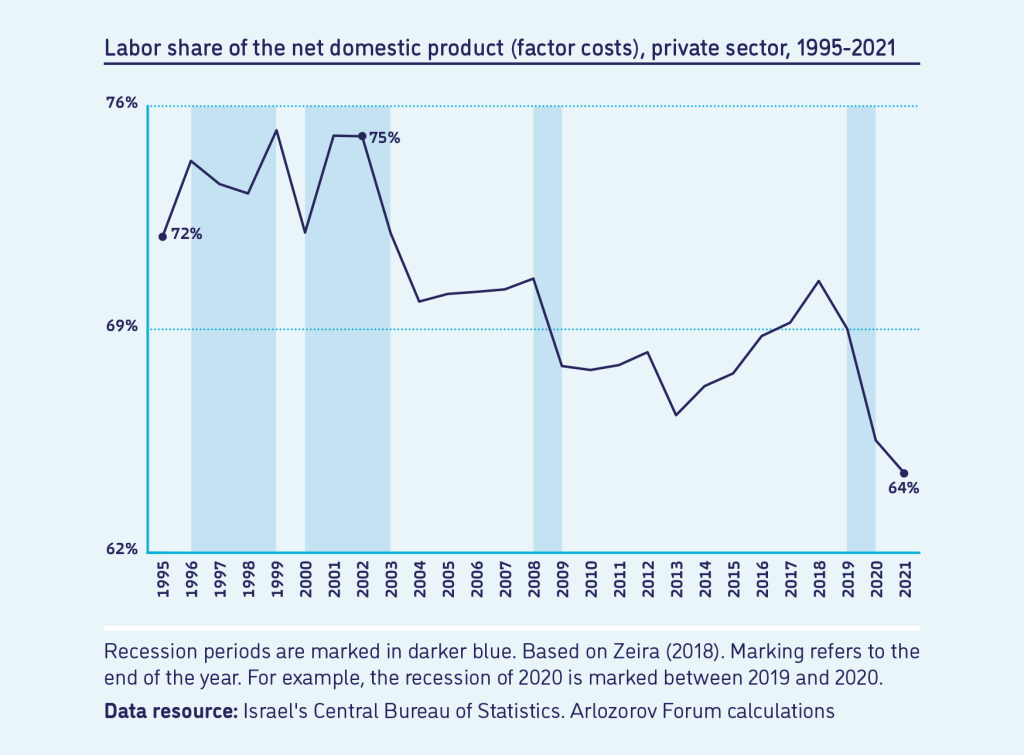
Another standpoint for viewing this trend is the decline of labor share in output. In other words, while the wages decoupled from productivity, the share in output that trickled down to the workers, in the form of wages and social benefits, gradually diminished – the share that made its way to the capital owners in the form of capital gains, has gradually increased.
From 1995 to 2003 the labor share in the product was relatively fixed, standing at 74% on average. Subsequently, over a decade there was a steady decline, which came to a halt in 2013 at which time a substantial increase took place in 2018 – up to 71%. Beginning in 2019, and throughout the Coronavirus period, we see a renewed drop in the labor share of the product, which in 2021 stood at only 64%.
In parallel with a decline in the labor share in the product, the return on net equity grew significantly. From 15% in 2002 it almost doubled and in 2021 it reached 27%.
The implications
90% of Israel’s population has relatively limited benefits from income from capital. It is certainly not as pronounced as the benefits enjoyed by the top decile. This means that income is transferred from the working public, the bulk of whose income is from work, into the hands of the capital owners.
If the link between productivity and returns to the workers had been maintained, then the average wage, from the workers’ standpoint, would have stood in 2021 at NIS 13,124 – approximately 11.5% higher than its current figure – NIS 11,773. Even if a gap between the workers’ shopping basket and that of the capital owners, another 4.5% would have been added the wage, which would have reached NIS 13,648 – a total addition of approximately 16% to the wage.
The reasons
This decoupling of wages from productivity and the decline of the labor share in the economic output, has been observed in industrialized countries since the 1980s. There is relatively broad agreement in economic literature as to the actual existence of this trend, however the reasons driving it are a matter of considerable debate.
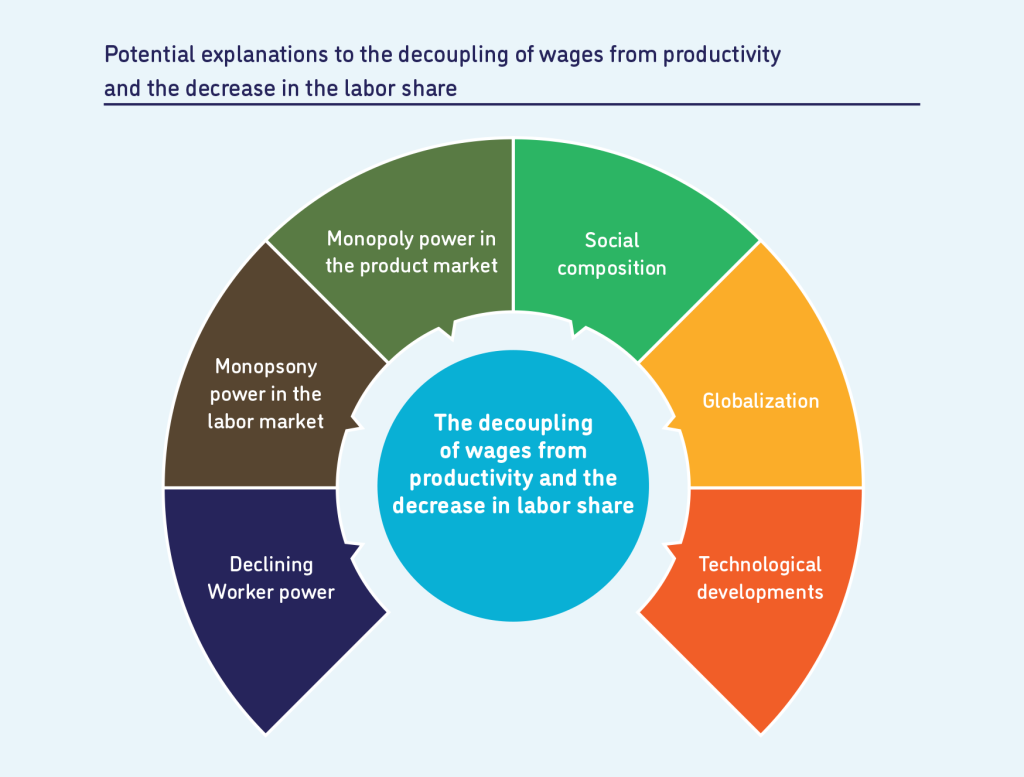
The main causes emerging as an explanation of this trend are technological progress, globalization, the makeup of the population, power in the product market (monopolies) and in the labor market (monopsonies). In recent years another explanation has been put forward in the economic literature – decline in workers’ power.
Research in Israel is relatively scarce; it indicates a deterioration in the workers’ bargaining power following demographic changes, weakening of the labor unions and changes in the government’s economic policy.
Summary
Decoupling of Wages from Productivity shows that a policy that focuses solely on increasing productivity will not be successful in raising the standard of living of the majority of Israeli residents.
In order to be successful in raising the standard of living of most residents, the causes shaping the workers’ wage system has to be attended to, and in particular the workers’ bargaining power has to be increased. Thus, instead of the wage mechanism widening the disparities and dividing income in a wealth-favorable manner, it will bring the fruits of the growth to the working public more fairly.
The government has got to implement a policy which will support the recoupling of the productivity and real wages by strengthening the workers’ bargaining power, for example through enlarging the percentage of organized workers and bolstering legislation which is protective of workers’ rights.