Collective Agreements
New labour standards in the private power generation sector
16.09.26
A groundbreaking study by the Arlozorov Forum has found that Israel is falling behind other advanced economies in preparing its labor market for the rapid integration of artificial intelligence (AI) systems, despite the technology’s growing presence in workplaces worldwide.
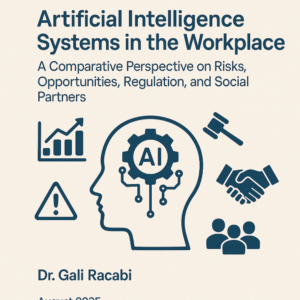
The report, authored by Dr. Gali Racabi of Cornell University, examines the risks, opportunities, and regulatory approaches to AI in the workplace across the United States, China, Germany, Scandinavia, South Korea, and South Africa, and compares them to Israel’s situation.
Key Findings: Limited Preparedness and Missed Opportunities
The research reveals that, unlike many countries, Israel has yet to develop a comprehensive national strategy for AI’s impact on employment. While some ministries have published general ethical and policy guidelines, there is no coordinated plan to regulate AI in hiring, workplace monitoring, or job restructuring.
“Political and public attention to AI’s labor market impact in Israel is minimal,” the report warns, noting that current responses rely largely on court rulings rather than proactive regulation. This stands in contrast to countries that have already implemented sector-specific AI regulations, collective bargaining frameworks, and worker protection measures.
Risks: From Job Losses to Privacy Violations
The study categorizes AI-related workplace risks at three levels:
Global Lessons for Israel
In its comparative review, the study highlights how:
Four-Level Plan for Israel
The Arlozorov Forum proposes a step-by-step national strategy:
AI as a Social Choice
Dr. Racabi stresses that AI’s effects are not predetermined: “The direction AI takes in the labor market depends on institutions, regulation, and adoption strategies. With the right policies, AI can promote both economic growth and social equality.”
The report concludes with a stark warning — without coordinated political action, Israel risks deepening inequality and missing AI’s potential to improve productivity, wages, and working conditions.

