
Collective Agreements
New labour standards in the private power generation sector
16.09.26
When missile fire disrupts daily life, the world of work is often the first arena to feel the impact. Workers face objective barriers: difficulty leaving home safely, the need to care for young children during school closures, and uncertainty about the availability and adequacy of protected spaces at their workplace. These challenges place enormous pressure on both workers and employers during times of crisis.
Despite these constraints, workers’ organisations, employers’ associations, and governments share a common objective: to maintain economic activity wherever possible, while ensuring the safety and well-being of citizens. The central question becomes: How can this be done effectively?
Adv. Hila Shienok, the Director of Policy of the Histadrut, explains the three pillars at the core of the practical model developed in Israel over the years of operating under missile fire:
Defining essential sectors and roles
Clear identification of essential industries, workplaces, and professions whose workers must continue operating even during emergencies, and establishing the legal duty for these workers to report.
Shifting all possible work to remote modalities
Whenever feasible, workers transition to remote work, reducing exposure to danger while keeping the economy functioning.
Establishing compensation mechanisms for those unable to work
A structured compensation system reimburses employers for revenue losses during emergencies, in exchange for a commitment to continue paying the salaries of non-essential workers who cannot report to work or work remotely.
These foundations form the basis for Israel’s broader emergency labour model, which the rest of this article explores in depth – highlighting the Histadrut’s role and offering practical steps for unions worldwide facing similar threats.
To understand the legal framework in Israel, it is important to note that when missile alerts sound, Israel’s entire economy operates under mandatory Home Front Command directives. This is backed by the Civil Defence Law (1951), which assigned them the responsibility to instruct emergency safety regulations.
Key directives that have a direct impact on the workforce include:
-Limits on gatherings, determining how many workers may be physically present at any workplace.
-Closure of schools and childcare facilities requires immediate support for working parents.
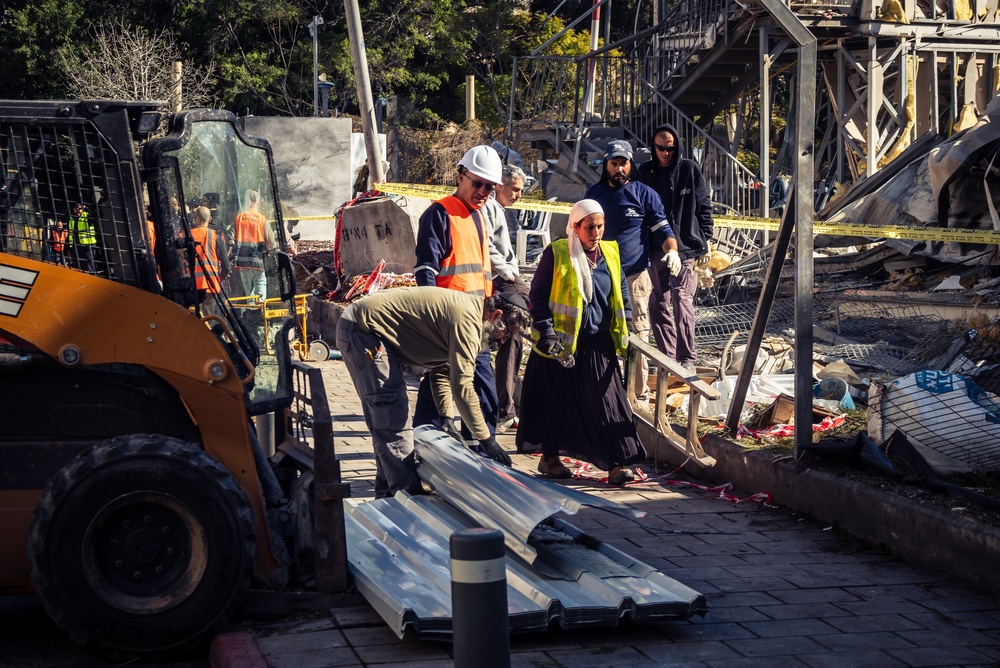
Some sectors must continue functioning regardless of danger. Healthcare teams, electricity and water technicians, public transport workers, welfare workers, and municipal staff are classified as essential and remain active even under fire.
To ensure these workers can report to duty, authorities must provide dedicated childcare and logistics for essential workers with children.
Histadrut’s role in supporting essential workers is straightforward: the national hotline and regional union teams address individual concerns, from parental responsibilities to entitlement to additional compensation upon reassignment. We advertise a question–and–answer page for essential workers with explanations of frequently asked questions, such as in which cases essential workers are allowed to stay at home. When workers are required to report to work farther from their usual workplace, the Histadrut negotiates and ensures additional compensation for the additional travel time and risk.

During declared emergencies, the Histadrut promotes special agreements that protect the wages of non-essential workers unable to report due to danger. When businesses are compensated for lost revenue or damage, we negotiate to ensure workers receive an appropriate share.
Security situations shift quickly, with closures and reopenings occurring sometimes daily. To manage this “accordion effect,” the Histadrut advocates for a flexible furlough system that can be activated immediately in line with emergency directives.
One of the most urgent challenges in wartime is safeguarding workers’ income in real time, not just after the fact. That is why the Histadrut works with the government and employers to secure agreements that provide clear financial guarantees during emergencies. On the 2nd of March, Acting Chairman Roi Yaakov urged the government to establish a permanent mechanism to reassure workers in future crises.
Although we consistently push for predefined, stable rules, each emergency still requires renegotiating the framework to reflect the evolving reality.
“If I can offer one piece of advice, it is this: understand as early as possible that trade unions and employers are on the same side. Reaching cooperation agreements and presenting joint demands to the government is essential, because protecting workers and keeping the economy functioning is a shared interest.”
Adv. Hila Shienok, the Director of Policy of the Histadrut.
Unions encountering missile attacks or similar disruptions for the first time can take immediate steps to protect workers. This is our advice for an effective emergency strategy:
Unions play a vital role in safeguarding workers under missile threats. The Israeli model offers a tested and structured approach to crisis labour management: one that balances the need for national continuity with the rights and safety of workers.
Adapting these principles can significantly strengthen resilience, reduce risk, and ensure that no worker is forced to choose between safety and livelihood.
Whether you are adapting the model to your national context or designing new emergency mechanisms, the Histadrut welcomes requests for knowledge exchange and is committed to supporting brother and sister unions affected by war.
This article was written by Adi Marcus, International Relations and Media Manager, International Relations Division of the Histadrut, with invaluable contributions from Adv. Hila Shienok, Director of Policy at the Histadrut, and Evyatar Hanan, Head of Policy and Strategy, Histadrut’s Policy Department.

