
Unionisation - Working for the workers of Israel
“Unionisation is essentially a fundamental act in the work of a trade union. The Histadrut, beyond everything else it represents, is at its core the largest and most significant trade union in Israel. And unionising is essentially the first step towards functioning as a trade union: organising more and more workers and bringing more and more workers into the circle of organised labour.”
Amihai Satinger – Director General of the Organizing Division

The freedom of association
In Israel, the freedom of association applies to both employees and employers. Within labour relations, it guarantees two fundamental rights to workers:
- The right to choose: The freedom of any employee to voluntarily join or establish a workers’ organisation, as well as the right not to join.
- Independence from state interference: The freedom to establish a workers’ organisation without requiring government permits or approval.
The freedom to form an association is set forth in section 33H of the Collective Agreements Law. Israeli court rulings mandate the employer’s obligation to conduct collective bargaining with its employees who are members of a representative workers’ organisation and protect the right of employees to conduct labour disputes.

The State of Israel has ratified two International Labour Conventions dealing with freedom of association:
- Convention No. 87 (1948): Freedom of Association and Protection of the Right to Organise.
- Convention No. 98 (1949): The Right to Organise and Collective Bargaining.
The economic benefits of organising
Globally: An OECD report highlighted that organised labour is critical to robust economic growth. Unionisation helps countries better navigate economic shocks, significantly reduces income inequality, and drives labour productivity.
Locally: A study by the Bank of Israel (by Hagai Etkes and Guy Almog) mirrored these global findings. The data revealed that, on average, unionised workers in Israel earn approximately 15% more than their non-unionised counterparts. Additionally, organised workers enjoy vastly superior employment stability and job security.
Key facts & protections
- Zero membership dues until an agreement is signed: The Histadrut does not collect membership dues from newly organising workplaces until their very first collective bargaining agreement is officially signed.
- Immediate access to benefits: Even before paying a single shekel in dues, organising workers immediately gain access to the Histadrut’s premium consumer and welfare benefits. This includes the “Together for You” (Beyachad Bishvilcha) consumer club, the Social Supermarket, the “Ovedim Bari” health app, subsidised higher education programs, and the “Friends” cultural network.
- Employer interference is strictly illegal: The right to unionise is heavily protected by Israeli law. Courts prohibit employers from interfering, threatening, or retaliating against unionisation efforts. Heavy financial penalties are routinely imposed on non-compliant employers.
- Existing benefits are protected: Unionising will never diminish your current perks. The Supreme Court has ruled that your existing working conditions serve as the baseline for negotiations. Employers are legally barred from cancelling benefits to punish workers for organising.
- Contract and agency workers: The right to unionise extends fully to contract and manpower agency workers. If one-third of an agency’s workforce joins, they can legally demand a collective agreement.
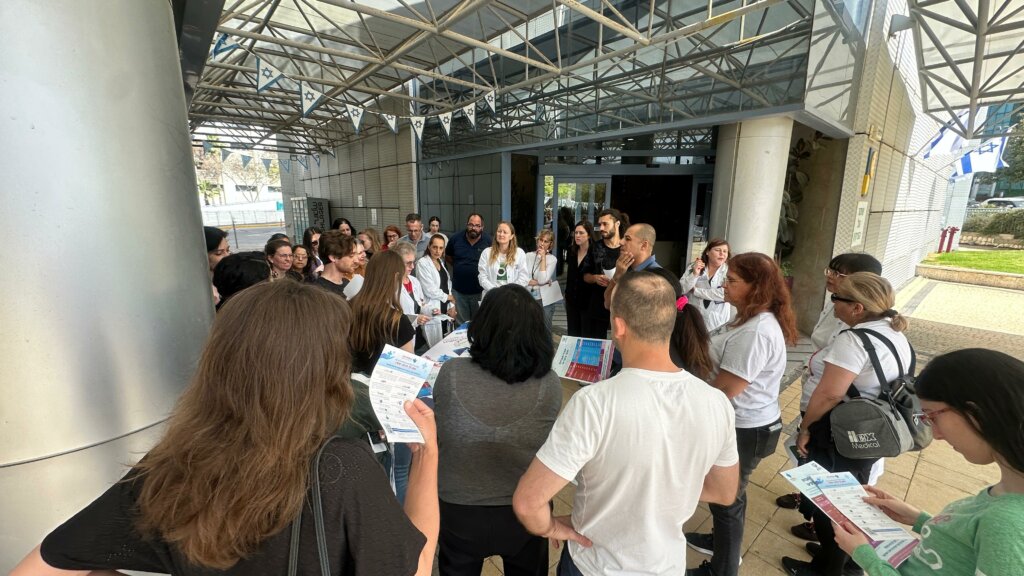
The 9 stages of Histadrut organising
Step 1: The initial contact
Would you be ready to make a change? It starts with a simple, confidential conversation. Contact the Histadrut’s Organising Division directly at 03-6921383, or reach our Information and Service Centre at *2383 (also available via WhatsApp at 054-8678673).
Step 2: Strategising with our experts
You will be paired with a professional organiser who will guide you every step of the way. Our team has helped tens of thousands of workers secure their jobs and improve their wages. Together, we will map out your workplace (company size, sector, locations) and establish a timeline.
Step 3: Building a core team
Behind every successful union is a dedicated team. At this stage, you will focus on rallying trusted, motivated colleagues who are ready to take an active role in leading the unionisation drive.
Step 4: Forming the action committee
Once a diverse group representing various departments is formed, you officially become the “Action Committee.” While still operating discreetly, we will meet to design your strategy, refine your core messaging, and plan for the public launch (including social media guidelines and employer communication).
Step 5: The launch and signing drive
After careful backstage planning, the initiative goes public. The Action Committee begins gathering signed Histadrut membership forms from colleagues. The goal is to reach as many coworkers as possible safely and efficiently.
Step 6: Strengthening grassroots momentum
We focus on maintaining momentum and reaching employees who haven’t signed yet. Transparent, peer-to-peer conversations help dispel any anxieties and reinforce the shared benefits of the change you are creating.
Step 7: Achieving official recognition
Once at least one-third (33%) of the workforce has signed, the Histadrut legally becomes the representative organisation at your workplace. We will formally notify the employer, demanding legal recognition and a date for the first negotiation meeting. If management refuses, the Histadrut will deploy its full legal and organisational weight to enforce compliance.
Step 8: Preparing for negotiations
Securing recognition is just the beginning. Backed by the Histadrut’s resource network, you will prepare for the bargaining table. Our specialised labour relations, legal, and economic units will help you draft a comprehensive list of the specific improvements you want to achieve.
Step 9: Launching collective bargaining
You will sit at the negotiating table backed by top-tier professionals. The Histadrut’s Economics Division will evaluate management’s financial offers to ensure genuine improvements, while our Legal Bureau will draft bulletproof contract clauses—ensuring your final collective agreement secures the rights, wages, and future of every worker.