Between green fantasy and burning reality: Can Israel afford to shut down Bazan?
The State Comptroller’s report casts doubt on the assumption that Israel can close a strategic refining infrastructure without endangering its energy security. In an energy‑isolated state dependent on vulnerable maritime imports, local production is a fundamental component of national resilience, not an aesthetic detail. Before dismantling an entire industrial ecosystem, a balanced strategy is needed, one that integrates energy security, environmental responsibility, and a just transition for workers.
This op‑ed is authored by Adam Blumenberg, Head of the Trade Union Division and Deputy Director for Economy and Policy at the Histadrut.
The latest State Comptroller’s report on the energy sector is not just a technical audit document. It is a resounding wake‑up call for anyone who planned Israel’s energy future within a fantasy reality, as though we were Switzerland. The report, published last week, places a glaring warning sign before the Israeli government: the decision to shut down Bazan (Resolution 1231) must undergo renewed examination, and the sooner the better.
Israel is an energy island. Unlike Europe, we have no cross-border electricity grids or backup pipelines from neighbouring countries. The report reveals that, despite growing dependence on natural gas, Israel has no storage reservoirs and lacks sufficient import terminals for liquefied natural gas. In such a situation, local distillate production at Bazan is the backbone of operational continuity.

The events of June 2025, “Operation Rising Lion”, proved this the hard way. The attack that shut down part of Bazan’s facilities demonstrated just how vulnerable the system is when a strategic installation is hit. But it also illustrated the other side of the coin; without local refining capability, the state relies on maritime imports that could be entirely disrupted during an emergency. The Comptroller determines that closing Bazan would increase dependence on LPG (cooking gas) imports through a single importer that would supply about 80% of consumption – a strategically reckless risk. We must not forget that three workers lost their lives to maintain the functional and energy continuity of the Israeli economy during that operation.
The efforts of local actors to push for the rapid removal of the Bazan complex, alongside the cluster of nearby companies and plants such as Carmel Olefins Ltd, too often focus on aesthetic visibility and landscape disturbance for observers in Carmel. Yet the bay is an integrated industrial ecosystem in which every link depends on the next. Shutting down one plant without understanding the broader implications for the supporting industries is a populist move that ignores reality. These plants supply critical raw materials to industry, agriculture, and security. Dismantling this system just to “clean the view,” without offering alternative strategic solutions, will result in a loss of industrial independence that will be extremely difficult to restore.
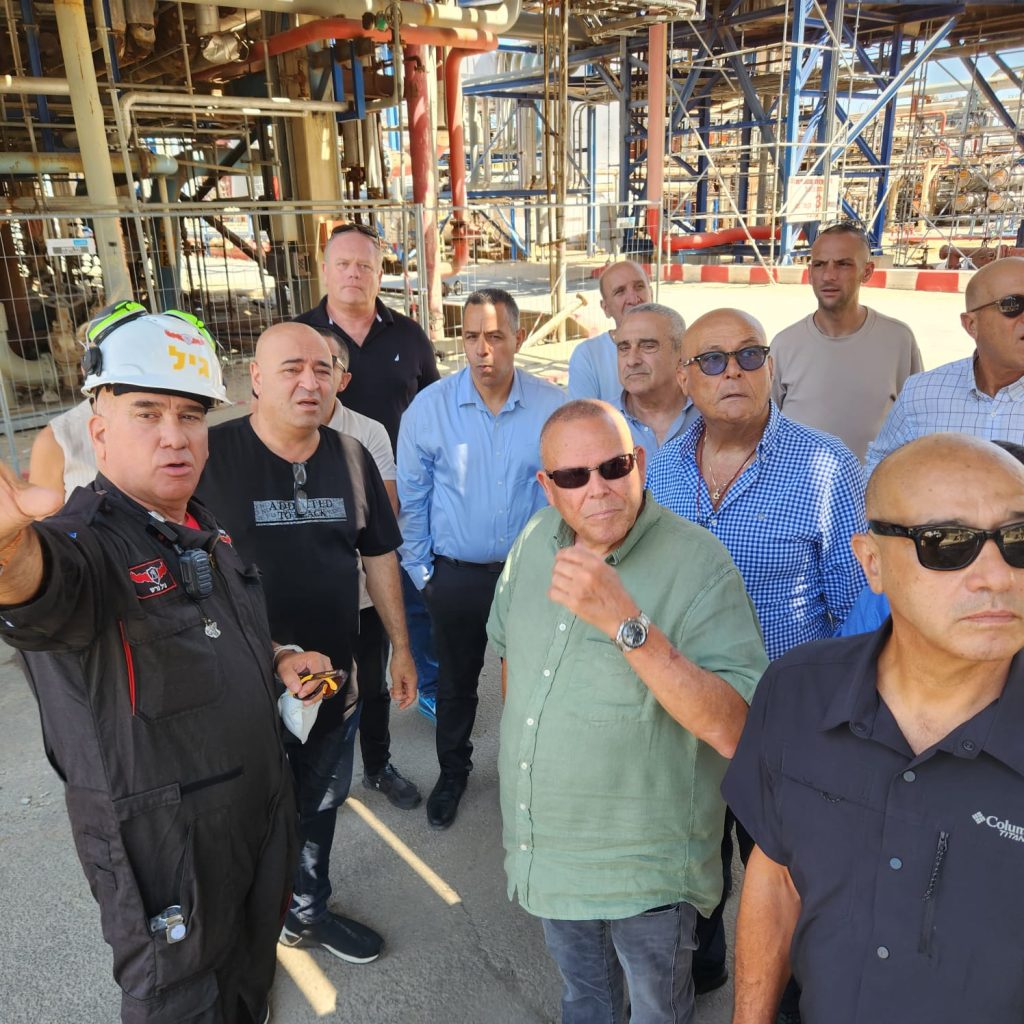
This is where the concept of “Just Transition” comes into play. It is a methodology that requires viewing all partners – from the government to the last worker – as part of a shared solution. A just transition requires investment in training and job placement for at‑risk workers, and a comprehensive assessment of the entire ecosystem – security and energy, employment and health.
We cannot discuss the bay’s future without taking the environmental issue seriously, but we must also ask what the true environmental and safety price of unpreparedness is. The Comptroller’s report reveals that the lack of structured legislation and supervisory powers makes it difficult for the Ministry of Energy to ensure that energy installations are properly prepared. There is a strategic paradox here: Resolution 1231 to shut down Bazan did not thoroughly examine the impact on the functioning of alternative energy infrastructures. Without supervised and advanced local production, the state will be forced to rely on massive maritime transport of fuels to vulnerable ports – a step that creates an environmental and security footprint no less dangerous. The correct path is not to “clean the view” by shifting the problem to the sea, but to invest in technological upgrading and to transform existing plants into clean and safe energy facilities as an inseparable part of national resilience.
We must consider an alternative to the binary approach of closure or pollution. Instead of simply erasing infrastructure, the state should consider upgrading the plants and turning them into a hub of green energy and clean industry. Such a conversion would preserve energy independence and operational infrastructure while meeting environmental targets and maintaining job security for thousands of families in northern Israel. Although there are about 3,000 workers in the first and direct employment circle of the bay, the implications are far broader; impacting about 25,000 workers, including truck drivers, construction and maintenance workers, subcontractors and suppliers serving the petrochemical industry.
Emergency preparedness depends on routine readiness. At present, Israel lacks structured legislation for the fuel sector in emergencies, and there is no agreement on the required inventory levels. Instead of rushing to shut down Bazan and the bay’s plants by 2029 based on outdated assumptions, the government must recalculate the route. We need to formulate a strategy that balances energy independence, a just transition for workers, and environmental protection. Energy security is not an aesthetic matter – it is a condition for our survival on the day of reckoning.
This op‑ed was originally published in Hebrew on the Bizportal website and can be viewed here.
Might interest you as well

Hundreds of construction sites across Israel halted activities on the National Day of Safety in Construction 2022




Confronting violence: Inspectors from Metropoline Ltd. will carry body cameras throughout their bus trips


Leaders of the Georgian Trade Union Confederation Show Solidarity with the Histadrut and Israeli People


Histadrut urges government to halt privatization plans in 2026 Economic Arrangements Bill

Social workers declare a labor dispute after government announcement of privatization


We live together, we work together, and when there is a siren, we run to the bomb shelter together.

Histadrut chairman: "If no steps are taken to eradicate violence against public servants - I will declare a labor dispute in the entire public sector."