SAP Israel workers protest attempt to cancel collective agreements
On Friday morning, SAP Israel employees, together with representatives of workers’ committees from across the economy, demonstrated outside the private residence of SAP Israel’s CEO, Orna Kleinmann. The protest reflected broad solidarity within the labour movement and sent a clear message: collective agreements are binding commitments, not discretionary arrangements that can be revoked unilaterally.
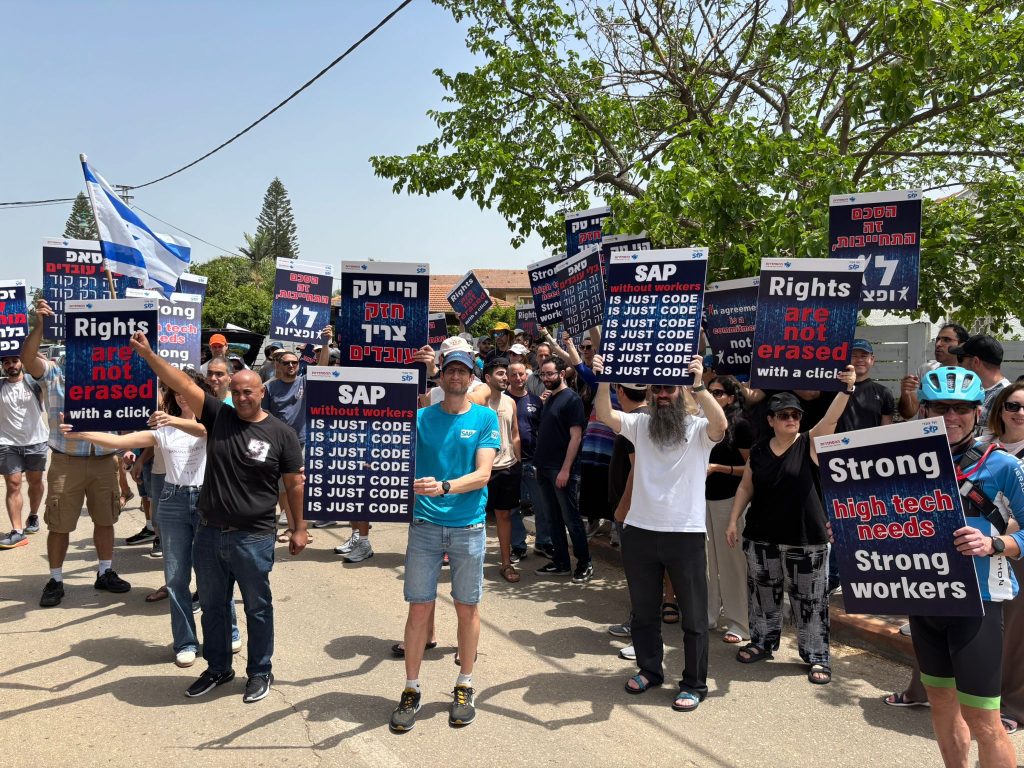
The Histadrut has, for more than a month, engaged in intensive, responsible dialogue with SAP Israel’s management to prevent this unprecedented step. It represents a serious deviation from accepted labour relations norms and risks undermining the foundations of social dialogue in Israel’s high‑tech sector. When these efforts failed to yield progress, we were compelled to declare a formal labour dispute in accordance with the law. Following the completion of the statutory waiting period, workers have now begun proportionate protest actions.
The Chair of the SAP Workers’ Committee, Gad Ravid, stated during the demonstration: “There is one address and one party responsible for the crisis the company has reached, and it is not the workers, but the CEO. We came here today to say this to her clearly. Even in the high‑tech sector, workers are human beings, and rights and agreements cannot be erased with the click of a button, as if we were Excel spreadsheets. We are open to negotiations, but we will not accept unilateral steps that harm the most dedicated and professional employees.”
International solidarity from UNI global union
SAP Israel workers received international backing from UNI Global Union, which represents millions of workers across many sectors, including in the global Information, Communications, Technology and Related Services (ICTS) sector. In a letter sent on 30 March, Benjamin Parton, Head of the ICTS Department of UNI, expressed deep concern over management’s attempt to terminate the collective agreement, emphasising that freedom of association and collective bargaining are fundamental labour rights. In his letter, Parton urged SAP Israel’s management to return to negotiations in good faith immediately. He concluded his letter by affirming UNI’s full solidarity with the workers and the Histadrut in defending democratic labour relations.
“We stand with you in defending collective bargaining, workers’ rights, and the principles that underpin democracy at work.”
Benjamin Parton, Head of the ICTS Department of UN
Collective bargaining is not optional
The collective agreement at SAP Israel, signed in 2017, remains valid and binding. While the technology sector is evolving rapidly, including the growing impact of artificial intelligence, change cannot serve as a pretext for bypassing collective bargaining or weakening workers’ protections. Adaptation to new technological realities must be achieved through negotiation, mutual respect, and good faith, not through unilateral action.
The Histadrut rejects any attempt to frame collective agreements as obstacles to innovation. On the contrary, stable labour relations and clear, negotiated frameworks are essential to sustainable growth, productivity, and workforce commitment—particularly in knowledge‑intensive industries such as high tech.
We remain fully committed to continuing negotiations with SAP Israel’s management, aiming to reach an updated collective agreement that reflects today’s realities while safeguarding workers’ rights. At the same time, we will not hesitate to use all lawful tools at our disposal to defend collective bargaining and prevent dangerous precedents.
Information for this article was taken from this publication by Davar.





Might interest you as well


Key Cooperation to Safeguard Israel's Agricultural Sector during the War Against Hamas

Histadrut responds to reports on “Hand Shakes Hand” affair: activities continue as usual

When solidarity becomes selective: How the trade union movement is undermining its own values on Israel

Histadrut declares labor dispute at Ribbon Communications Israel over planned workforce cuts

Compensation framework for public sector workers affected by operation Lion's Roar
In celebration of its 103 Years of Global Advocacy for Workers' Rights, we take a look at the Histadrut’s Ongoing Partnership and Achievements with the IUF




Arnon Bar-David: "The rift emerging from the Knesset is dismantling our life creation."
New extension order was signed following a collective agreement covering the monitoring & patrol services
Hundreds of construction sites across Israel halted activities on the National Day of Safety in Construction 2022
Histadrut leads parliamentary discussion on expanding employment opportunities for people with disabilities